
Understanding Your Risk: Why Consider Heart Screening?
Heart disease is a significant health concern in Singapore, often developing silently over many years. For many busy professionals and dedicated family members, the first sign of trouble can be a sudden, major cardiac event. This reality drives a critical question: how can you understand your true heart risk before symptoms appear? While we live in a food paradise, dietary habits, combined with sedentary lifestyles and high-pressure work environments, contribute to the rising prevalence of cardiovascular issues. The statistics from Singapore’s Ministry of Health consistently place cardiovascular disease as a leading cause of mortality, a sobering reminder of the importance of proactive health management.
Heart Disease in Singapore: The Silent Threat
The development of heart disease is often a gradual process. Atherosclerosis, which is the hardening and narrowing of the arteries, is at the root of most problems. It begins when fats, cholesterol, and other substances build up in the walls of your arteries, forming hard structures called plaques. Over time, these plaques can grow and restrict blood flow. If a plaque ruptures, it can trigger a blood clot that leads to a heart attack or stroke. Many people with significant atherosclerosis have no symptoms. They may have normal cholesterol on a blood test and feel perfectly healthy, yet silently carry a high risk for a future cardiac event. This is why relying solely on symptoms to gauge heart health can be a dangerous waiting game.
Traditional Risk Factors vs. Direct Imaging
For decades, doctors have assessed heart disease risk using a combination of factors. These include blood pressure readings, cholesterol and blood sugar levels, family history of heart disease, smoking status, and Body Mass Index (BMI). These are known as traditional risk factors, and they are essential components of any health evaluation. However, they are indirect markers. They provide a statistical probability of risk rather than a direct look at the arteries themselves. Two individuals with the exact same risk factor profile can have vastly different amounts of plaque in their arteries. This is where advanced, non-invasive imaging comes in. Technologies like CT scans allow doctors to look directly at the coronary arteries to see and measure the plaque burden, offering a personalized and far more accurate assessment of your actual risk.
Who Should Consider a Heart Screening?
Non-invasive heart screening is not for everyone. It is most valuable for asymptomatic individuals who want to better understand their future risk. In Singapore, a doctor might recommend these screenings for:
- Men aged 40 and above or women aged 50 and above.
- Individuals with a strong family history of premature heart disease (a father or brother diagnosed before age 55, or a mother or sister before age 65).
- Those with borderline or intermediate risk factors, where it is unclear if they would benefit from lifelong medication like statins.
- People with conditions like diabetes or high blood pressure who want a more precise risk assessment.
- Individuals seeking a comprehensive understanding of their health to guide lifestyle changes and preventative strategies.
The goal is to identify hidden risks early, allowing for timely and effective intervention to prevent a future heart attack, not just react to it.
A Closer Look at Coronary Artery Calcium Scoring
One of the most powerful and well-established tools for non-invasive heart risk assessment is the Coronary Artery Calcium (CAC) score, often just called a calcium score. It is a simple, fast, and painless test that provides a direct measure of your plaque burden, offering a window into the health of your coronary arteries.
What is a Calcium Score?
A calcium score is a specialized computed tomography (CT) scan of the heart that specifically looks for and quantifies calcified plaque in the coronary arteries. While plaque contains cholesterol and other soft substances, calcium is deposited as part of the body’s inflammatory response to this plaque over time. The presence of calcium is a clear marker for the presence of atherosclerosis. The CT scanner takes multiple cross-sectional images of your heart, and a computer program then identifies the calcium deposits and calculates a score based on their extent. Think of it as an arterial mammogram; it detects potential problems long before they become emergencies.
How the Calcium Scoring Test is Performed
The procedure is remarkably straightforward and requires very little preparation. You do not need to fast, and you will not receive any injections or contrast dye. When you arrive for the scan, you will change into a medical gown and have several ECG (electrocardiogram) electrodes placed on your chest. These electrodes help synchronize the CT scanner with your heartbeat to ensure the images are clear and sharp. You will then lie on a table that slides into the center of the doughnut-shaped CT scanner. You will be asked to hold your breath for a few seconds at a time while the machine takes pictures. The entire process typically takes only 10 to 15 minutes, with the scan itself lasting less than a minute. It is completely painless, and you can resume your normal activities immediately afterward.
Interpreting Your Calcium Score (Agatston Score)
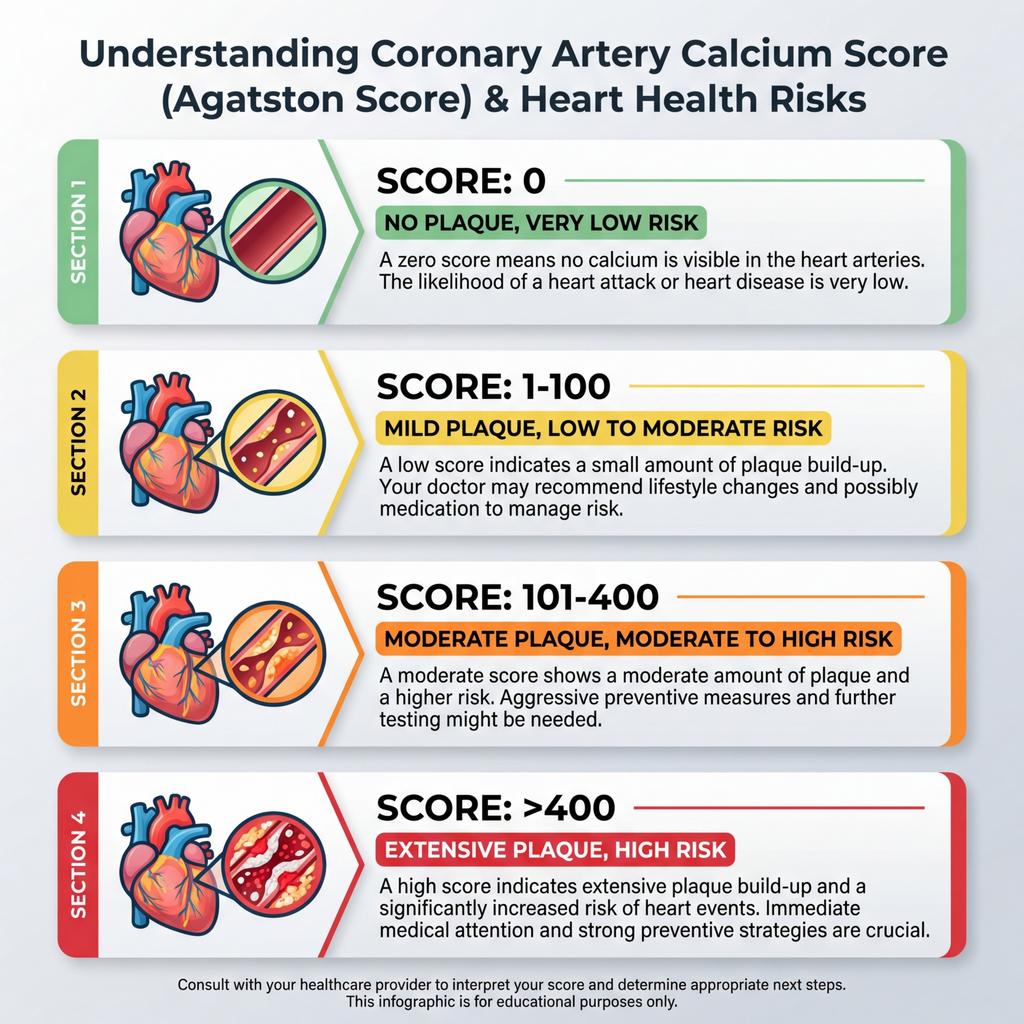
The result of the test is a number known as the Agatston score. This score reflects the total amount of calcified plaque detected. The interpretation is generally as follows:
- Score of 0: No calcified plaque detected. This indicates a very low risk of a heart attack in the next five to ten years. It is a very reassuring result.
- Score of 1 to 100: Mild plaque burden. This indicates a low to moderate risk. It confirms the presence of heart disease, and lifestyle modifications are strongly recommended. Your doctor may also discuss medication.
- Score of 101 to 400: Moderate plaque burden. This signifies a moderate to high risk of a future cardiac event. It is a clear call to action, and your doctor will likely recommend aggressive risk factor management, including diet, exercise, and medication such as statins.
- Score above 400: Extensive plaque burden. This indicates a high risk. It suggests significant atherosclerosis, and your doctor will initiate intensive medical therapy and may recommend further testing to check for significant blockages.
It is crucial to understand that a calcium score is a risk prediction tool, not a blockage detector. A high score means you have a lot of plaque and a high risk, but it does not tell you if any of that plaque is causing a severe narrowing in an artery.
What Happens After a High Calcium Score?
Receiving a high calcium score is not a cause for panic; it is a powerful opportunity for prevention. The result empowers you and your doctor to take decisive action. The conversation will shift from “if” you should be treated to “how aggressively” you should be treated. This typically involves a multi-pronged approach: intensive lifestyle changes focusing on a heart-healthy diet and regular physical activity, and often the initiation of medication like statins to lower cholesterol and stabilize plaque, and sometimes aspirin to prevent blood clots. Depending on the score and your overall clinical picture, your doctor might also suggest a functional test (like a stress test) or a more detailed imaging test like a CT Coronary Angiogram to check for significant narrowing.
CT Coronary Angiography (CTCA): Visualising Your Arteries
While a calcium score quantifies risk by measuring hard plaque, a CT Coronary Angiogram (CTCA) goes a step further. It is an advanced diagnostic imaging test that provides a detailed 3D map of the coronary arteries, allowing doctors to see not only if plaque is present, but also its exact location and, most importantly, if it is causing significant narrowing or blockage.
What is a CT Coronary Angiogram?
A CTCA is a more involved CT scan that uses an iodine-based contrast dye to visualize the coronary arteries. The contrast dye is injected into a vein in your arm, and it travels through your bloodstream to your heart. As the dye fills the coronary arteries, the CT scanner captures high-resolution images. These images are then reconstructed by a powerful computer to create a detailed 3D model of the arteries. This allows a cardiologist or radiologist to virtually fly through the arteries, examining them from every angle to identify any areas of narrowing (stenosis). Critically, CTCA can detect both calcified (hard) plaque and non-calcified (soft) plaque, which is often more vulnerable to rupture and can be missed by a calcium score alone.
The Key Difference: Calcium Score vs. CTCA
The distinction between these two tests is fundamental. A Calcium Score is a risk assessment tool. It answers the question: “How much calcified plaque do I have, and what is my future risk of a heart attack?” It is a screening test for asymptomatic individuals. A CT Coronary Angiogram is a diagnostic tool. It answers the question: “Are there significant blockages in my arteries that are limiting blood flow right now?” It is typically used for patients who have symptoms (like chest pain or shortness of breath), an abnormal stress test result, or a very high calcium score that warrants a closer look for severe disease.

The CTCA Procedure: What to Expect
Preparation for a CTCA is more extensive than for a calcium score. You will likely be asked to fast for a few hours before the test and to avoid caffeine and other stimulants for 24 hours, as they can increase your heart rate. A higher heart rate can blur the CT images, so the goal is to have it slow and steady. To achieve this, your doctor may give you a medication called a beta-blocker to take before the scan. At the clinic, an IV line will be placed in your arm for the contrast injection. Like the calcium score, ECG leads will be placed on your chest. During the scan, as the contrast is injected, you may feel a warm sensation throughout your body and a metallic taste in your mouth; this is normal and temporary. The scan itself is very quick, requiring you to hold your breath for several seconds. The entire appointment may take about an hour to allow for preparation and observation after the procedure.
Who is a Candidate for CTCA in Singapore?
CTCA is a powerful diagnostic test reserved for specific situations. It is generally not considered a first-line screening test for the general population without symptoms, due to the use of contrast dye and a higher radiation dose compared to a simple calcium score. In the Singaporean context, a doctor would typically recommend a CTCA for:
- Patients presenting with atypical chest pain where the cause is unclear.
- Individuals with an inconclusive or equivocal result from a stress test.
- Evaluating complex coronary anatomy or bypass grafts.
- As a follow-up investigation after a very high calcium score to determine the extent and severity of artery narrowing.
It serves as a non-invasive alternative to a conventional coronary angiogram, which is an invasive procedure involving a catheter inserted through an artery in the wrist or groin.
Navigating Heart Screenings in Singapore’s Healthcare System
Understanding the value of these tests is the first step. The next is knowing how to access them within the local healthcare framework and what to expect from the process. Proactive health management is well-supported in Singapore, with clear pathways for patients to get the care they need.
Accessing These Tests
The journey to a heart screening typically begins with a consultation. This can be with your regular General Practitioner (GP) or directly with a cardiologist. During this consultation, the doctor will conduct a thorough assessment of your personal and family medical history, traditional risk factors, and any symptoms you might have. Based on this comprehensive evaluation, they will determine if a heart screening is appropriate for you and which test—a calcium score or a CTCA—is the right choice. These tests are widely available in both public and private hospitals across Singapore, equipped with modern imaging technology.
Costs and Subsidies
The cost of these advanced imaging tests can vary depending on the institution (public vs. private) and the specifics of the procedure. It is a practical consideration for many. It is advisable to inquire about the costs upfront. Patients should also check on their eligibility for using Medisave or private insurance coverage for these procedures. Often, if the test is deemed medically necessary by a doctor for diagnostic purposes, part of the cost may be claimable. For elective screening, coverage policies can differ, so it is always best to verify with your insurance provider directly.
The Role of Your Doctor in the Process
It cannot be overstated how important a doctor’s guidance is in this process. Self-referring for a scan without a prior medical evaluation is not recommended. The results of a calcium score or CTCA are not just numbers; they are complex pieces of data that must be interpreted within the context of your entire health profile. Your doctor plays a vital role in recommending the right test, explaining the results to you in a clear and understandable way, and developing a personalized management plan based on the findings. This partnership ensures that the information gained from the scan is translated into meaningful, life-saving action.
Taking Proactive Steps for Your Heart Health
Heart disease remains a formidable challenge in Singapore, but advances in non-invasive screening have equipped us with powerful tools for early detection and prevention. Tests like the CT Calcium Score and CT Coronary Angiogram move us from an era of reacting to heart attacks to one of proactively identifying risk and preventing them from ever happening. They provide a personalized look at your cardiovascular health, allowing for tailored strategies that can significantly alter your future health trajectory.
The key takeaways are clear. First, know your traditional risk factors like blood pressure, cholesterol, and blood sugar, and work with your doctor to manage them. Second, have an open conversation with your doctor about your personal and family history to determine if a non-invasive heart screening is a suitable next step for you. Finally, remember that these tests are just one part of a holistic approach to heart health. The most impactful changes are often the ones you can make every day.
This includes making healthier food choices, such as opting for steamed dishes over fried ones at the hawker centre, incorporating regular physical activity into your weekly routine, finding effective ways to manage stress, and stopping smoking. These lifestyle foundations are the most powerful medicine of all. Embracing these proactive steps, guided by insights from modern medicine, is the best investment you can make in a long and healthy life.
This article is for general informational purposes only and does not constitute medical advice. Please consult a qualified healthcare professional for any health concerns or before making any decisions related to your health or treatment.

Jeremy Lee is a seasoned digital marketing director and strategist with over two decades of experience in the industry. As the founder of Sotavento Medios, I manage a diverse portfolio of over 50 businesses, helping brands grow through advanced search strategies and digital innovation. My work focuses on bridging the gap between traditional search engine optimisation and the evolving world of AI-driven answer engines.