
For many in Singapore, a hernia can be a concerning, often misunderstood condition. It is a common surgical problem, and while the term “hernia” might bring to mind a general bulging sensation, there are distinct types, each with unique characteristics and risks. Among the most prevalent are inguinal and femoral hernias, both occurring in the groin region but differing significantly in their anatomy, typical patient profiles, and potential complications. Understanding these differences is not merely an academic exercise; for Singaporeans aged 25-65, especially those who lead active lifestyles or have predisposing factors, this knowledge is crucial for timely recognition and appropriate medical intervention. This article aims to provide a comprehensive, evidence-based guide to distinguishing between inguinal and femoral hernias, outlining their causes, symptoms, risks, and management strategies, all within the context of healthcare accessibility and lifestyle considerations in Singapore.
What is a Hernia? A General Overview
Before delving into the specifics of inguinal and femoral hernias, it is important to understand what a hernia fundamentally is. A hernia occurs when an internal organ, or a part of an organ, protrudes through a weakness in the muscle or tissue wall that normally contains it. Think of it like a tire with a weak spot; internal pressure causes a bulge to form. While hernias can occur in various parts of the body, the most common types are found in the abdominal wall, particularly in the groin area. The primary concern with any hernia is the risk of complications, especially if the protruding tissue becomes trapped or loses its blood supply.
Common Types of Hernias
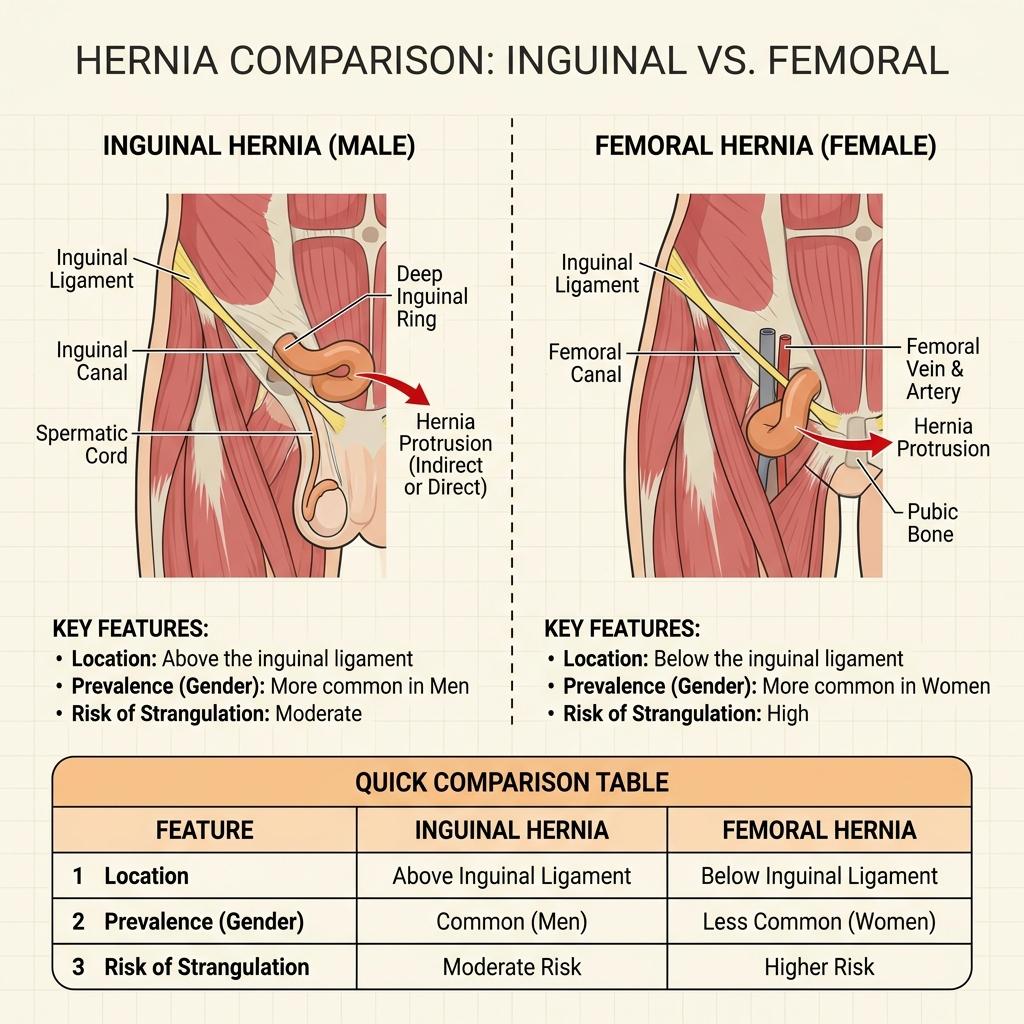
- Inguinal Hernias: These are the most common type, making up about 75% of all abdominal wall hernias. They occur in the groin, specifically when part of the intestine or fatty tissue pushes through a weak spot in the abdominal wall, often into the inguinal canal.
- Femoral Hernias: Less common than inguinal hernias, femoral hernias also occur in the groin but specifically pass through the femoral canal, a narrow passage located just below the inguinal ligament.
- Umbilical Hernias: Occur near the belly button (umbilicus).
- Incisional Hernias: Develop at the site of a previous surgical incision.
- Hiatal Hernias: Occur when part of the stomach pushes up through the diaphragm into the chest cavity.
Inguinal Hernias: The Most Common Groin Protrusion
Inguinal hernias derive their name from the inguinal canal, a passage in the abdominal wall located in the groin. This canal serves as a pathway for structures to pass between the abdomen and the genitals. In males, it is the route for the spermatic cord (containing blood vessels, nerves, and the vas deferens) to descend into the scrotum. In females, it contains the round ligament of the uterus. A weakness in the abdominal muscles along this canal can allow abdominal contents to push through, forming a bulge.
Types of Inguinal Hernias
- Indirect Inguinal Hernia: This is the more common type and is often congenital, meaning it is present from birth. It occurs when a portion of the intestine protrudes through the deep inguinal ring, often following the path that the testicles took during development into the scrotum. It can occur at any age but is more common in younger individuals.
- Direct Inguinal Hernia: This type typically develops in adulthood and is caused by a weakening of the abdominal muscles in the floor of the inguinal canal, specifically Hesselbach’s triangle. It does not follow the same congenital path as an indirect hernia and rarely descends into the scrotum.
Causes and Risk Factors for Inguinal Hernias
The primary cause of an inguinal hernia is a pre-existing weakness in the abdominal wall. This weakness can be congenital, as seen in indirect hernias, or it can develop over time due to factors that increase intra-abdominal pressure. Common risk factors include:
- Gender: Men are significantly more prone to inguinal hernias than women due to anatomical differences related to the descent of the testes.
- Age: The risk increases with age as abdominal muscles naturally weaken.
- Chronic Cough: Conditions like chronic bronchitis or smoking can lead to persistent coughing, increasing abdominal pressure.
- Chronic Constipation: Straining during bowel movements can put significant pressure on the abdominal wall.
- Heavy Lifting: Occupations or activities involving frequent heavy lifting can contribute to muscle strain and weakness.
- Obesity: Excess weight adds to intra-abdominal pressure.
- Pregnancy: While more common for umbilical hernias, the increased abdominal pressure during pregnancy can also contribute to inguinal hernia risk in women.
- Family History: A genetic predisposition can increase susceptibility.
Symptoms of Inguinal Hernias
The most common symptom is a noticeable bulge in the groin area, particularly when standing, coughing, or straining. This bulge may disappear when lying down. Other symptoms can include:
- Pain or discomfort in the groin, especially with bending, lifting, or coughing.
- A heavy or dragging sensation in the groin.
- Burning or aching sensation at the site of the bulge.
- In men, pain and swelling around the testicles if the hernia descends into the scrotum.
Femoral Hernias: A Less Common, Higher-Risk Counterpart
Femoral hernias are less common than inguinal hernias, accounting for approximately 3-5% of all groin hernias. They occur when a portion of the intestine or fatty tissue pushes through a weak spot in the abdominal wall into the femoral canal. The femoral canal is a tight passageway located just below the inguinal ligament, alongside the femoral artery and vein, and is typically a small space. Its narrow nature is a key factor in the higher risk of complications associated with femoral hernias.
Who is Affected by Femoral Hernias?
Femoral hernias are significantly more common in women than in men, particularly older women who have had multiple pregnancies. This predisposition is thought to be due to the wider bony pelvis in women, which creates a larger femoral canal. Other risk factors are similar to those for inguinal hernias, including increased abdominal pressure from chronic coughing, constipation, heavy lifting, and obesity.
Causes and Risk Factors for Femoral Hernias
Similar to inguinal hernias, the underlying cause is a weakness in the abdominal wall, exacerbated by factors that increase intra-abdominal pressure. Specific contributing factors for femoral hernias include:
- Female Gender: As mentioned, this is a significant predisposing factor.
- Multiple Pregnancies: Can weaken the abdominal wall and pelvic floor structures.
- Obesity: Increases pressure within the abdomen.
- Chronic Cough or Constipation: Persistent straining can contribute to the development of a hernia.
- Previous Abdominal Surgery: Can sometimes alter anatomical structures or create areas of weakness.

Symptoms of Femoral Hernias
The symptoms of a femoral hernia can be similar to an inguinal hernia, presenting as a bulge in the groin. However, the bulge from a femoral hernia is typically smaller, lower, and closer to the upper thigh than an inguinal hernia. It may also be more difficult to detect, especially in individuals with obesity. Common symptoms include:
- A lump or bulge in the groin area, often below the inguinal ligament and closer to the inner thigh.
- Pain or discomfort in the groin, which may worsen with activity.
- Sometimes, a dull ache or heavy sensation.
- Due to the narrowness of the femoral canal, femoral hernias are more prone to complications, and symptoms of strangulation (severe pain, tenderness, nausea, vomiting) can develop rapidly.
Differentiating Inguinal and Femoral Hernias
While both types present as bulges in the groin, crucial anatomical differences help distinguish them:
- Location of the Bulge: An inguinal hernia bulge is typically above the inguinal ligament, often extending towards the pubic bone or into the scrotum in men. A femoral hernia bulge is usually below the inguinal ligament, closer to the inner thigh.
- Gender Predominance: Inguinal hernias are far more common in men; femoral hernias are more common in women.
- Risk of Complications: Femoral hernias have a significantly higher risk of complications like incarceration (when the hernia becomes trapped and cannot be pushed back in) and strangulation (when the blood supply to the trapped tissue is cut off) due to the narrowness of the femoral canal.
- Presentation: Inguinal hernias can be larger and more obvious. Femoral hernias can be smaller, harder to detect, and sometimes only discovered during a physical examination or when complications arise.
Risks and Complications
Untreated hernias, both inguinal and femoral, can lead to serious complications. The most significant risks are:
- Incarceration: This occurs when the protruding tissue (often a loop of intestine) becomes trapped in the hernia sac and cannot be pushed back into the abdomen. While not immediately life-threatening, it can be very painful and often requires emergency surgery.
- Strangulation: This is a severe and life-threatening complication that can arise from incarceration. If the trapped tissue has its blood supply cut off, it can lead to tissue death (necrosis) and gangrene, requiring immediate surgical intervention to prevent peritonitis (infection of the abdominal lining) or sepsis. Femoral hernias have a higher incidence of strangulation compared to inguinal hernias due to the tighter confines of the femoral canal.
- Obstruction: If a segment of the intestine is incarcerated, it can lead to an intestinal obstruction, preventing the passage of food and waste, causing severe abdominal pain, nausea, and vomiting.
For individuals in Singapore experiencing any symptoms of a hernia, particularly sudden, severe pain, tenderness, nausea, or vomiting alongside a groin bulge, it is imperative to seek urgent medical attention. Waiting can dramatically increase the risk of severe, life-threatening complications.
Diagnosis and Treatment Options in Singapore
Diagnosing a groin hernia typically involves a physical examination by a medical professional. The doctor will examine the groin area for a bulge, often asking the patient to stand, cough, or strain, which can make the hernia more prominent. In some cases, imaging tests such as an ultrasound, CT scan, or MRI may be used to confirm the diagnosis, especially if the hernia is small or the diagnosis is unclear. These diagnostic tools are readily available across public and private healthcare institutions in Singapore.
Treatment for Hernias
The definitive treatment for both inguinal and femoral hernias is surgical repair, known as a herniorrhaphy or hernioplasty. There are generally two main surgical approaches:
- Open Hernia Repair: This involves making a single incision in the groin area. The surgeon pushes the protruding tissue back into the abdomen and then reinforces the weakened abdominal wall, usually with a synthetic mesh. This mesh acts as a scaffolding for new tissue growth, strengthening the area and reducing the risk of recurrence.
- Laparoscopic (Keyhole) Hernia Repair: This minimally invasive technique involves making several small incisions in the abdomen. A laparoscope (a thin tube with a camera) and surgical instruments are inserted through these incisions. The surgeon repairs the hernia from within the abdomen, typically using a mesh to reinforce the weak area. This method often results in less post-operative pain, smaller scars, and a quicker recovery time.
The choice between open and laparoscopic repair depends on several factors, including the type and size of the hernia, the patient’s overall health, previous surgical history, and the surgeon’s expertise. Both options are widely available in Singapore. Patients should discuss the most suitable approach with their surgeon.
Recovery and Lifestyle Management in Singapore
After hernia repair surgery, recovery typically involves a period of rest and limited activity. Patients are usually advised to avoid heavy lifting and strenuous activities for several weeks to allow the surgical site to heal. Pain management is crucial, and doctors will prescribe appropriate medication. In Singapore, post-operative care often includes follow-up appointments with the surgeon and advice from nurses on wound care and activity restrictions. Incorporating a healthy lifestyle is key to preventing recurrence, which includes:
- Maintaining a Healthy Weight: Reducing excess abdominal pressure.
- Eating a Fibre-Rich Diet: Preventing constipation and straining during bowel movements. Many local Singaporean fruits and vegetables are excellent sources of fibre.
- Regular Exercise: Strengthening core abdominal muscles, but avoiding exercises that put undue strain on the groin during recovery.
- Avoiding Smoking: Reducing chronic cough, a significant risk factor.
- Proper Lifting Techniques: Bending at the knees and using leg muscles rather than the back and abdomen.
Prevention and When to Seek Medical Attention
While some hernias, especially indirect inguinal hernias, have a congenital component and are not entirely preventable, certain lifestyle modifications can reduce the risk of developing or worsening others. These include managing chronic conditions that cause coughing or straining, maintaining a healthy weight, and practicing safe lifting techniques. Regular physical activity can also help strengthen the abdominal wall.
It is vital for Singaporeans to be aware of the symptoms and to seek medical attention promptly if a bulge or discomfort in the groin is noticed. Early diagnosis and elective surgical repair can prevent the progression to more serious complications like incarceration or strangulation. If you experience a sudden, painful, tender, or discolored lump in your groin accompanied by nausea, vomiting, or fever, consider this a medical emergency and proceed to the nearest Accident & Emergency department immediately. Prompt action in such cases can be life-saving and significantly impacts the prognosis.
Conclusion
Inguinal and femoral hernias, though both located in the groin, are distinct conditions with different anatomical pathways, predominant patient groups, and levels of risk. While inguinal hernias are more common, femoral hernias carry a higher propensity for serious complications such as strangulation due to the narrowness of the femoral canal. Understanding these differences empowers individuals to recognize symptoms early and seek timely medical intervention. In Singapore, with its advanced healthcare infrastructure, both diagnosis and effective surgical treatment are readily available. By being proactive about groin discomfort, adhering to healthy lifestyle practices, and seeking professional medical advice when symptoms arise, Singaporeans can effectively manage their health and mitigate the risks associated with these common yet potentially serious conditions. Remember, any persistent bulge or pain in the groin warrants a consultation with a doctor; early intervention is always the best course of action.

Jeremy Lee is a seasoned digital marketing director and strategist with over two decades of experience in the industry. As the founder of Sotavento Medios, I manage a diverse portfolio of over 50 businesses, helping brands grow through advanced search strategies and digital innovation. My work focuses on bridging the gap between traditional search engine optimisation and the evolving world of AI-driven answer engines.