
Why Your Daily Commute in Singapore Requires Serious Sun Protection
Stepping out of your home in Singapore, you are immediately enveloped in the familiar wave of tropical heat and humidity. Your daily commute, whether it is a brisk walk to the MRT station, waiting at a bus stop, or even driving your car, might seem like a brief and harmless part of your day. Many of us think, “It’s only ten minutes under the sun, what harm could it do?” This common misconception is one of the most significant oversights we make for our long term skin health. In a city positioned just one degree north of the equator, incidental sun exposure is not a trivial matter. The cumulative effect of these short, daily exposures poses a substantial threat to your skin’s health and appearance, contributing to premature aging and increasing the risk of skin cancer. This is why treating sunscreen as an optional step in your morning routine is a mistake. Specifically, relying on anything less than a high protection, broad spectrum SPF 50 product is non negotiable for anyone living and working in Singapore.
Understanding Singapore’s Unique UV Challenge
Living in Singapore means being exposed to one of the most intense levels of ultraviolet (UV) radiation in the world. Our geographical location is the primary reason for this. The sun’s rays strike the equator more directly than any other part of the planet, resulting in a consistently high UV Index throughout the year. Understanding the science behind this environmental factor is the first step in appreciating the need for diligent sun protection.
The Science of Solar Radiation: UVA, UVB, and the UV Index
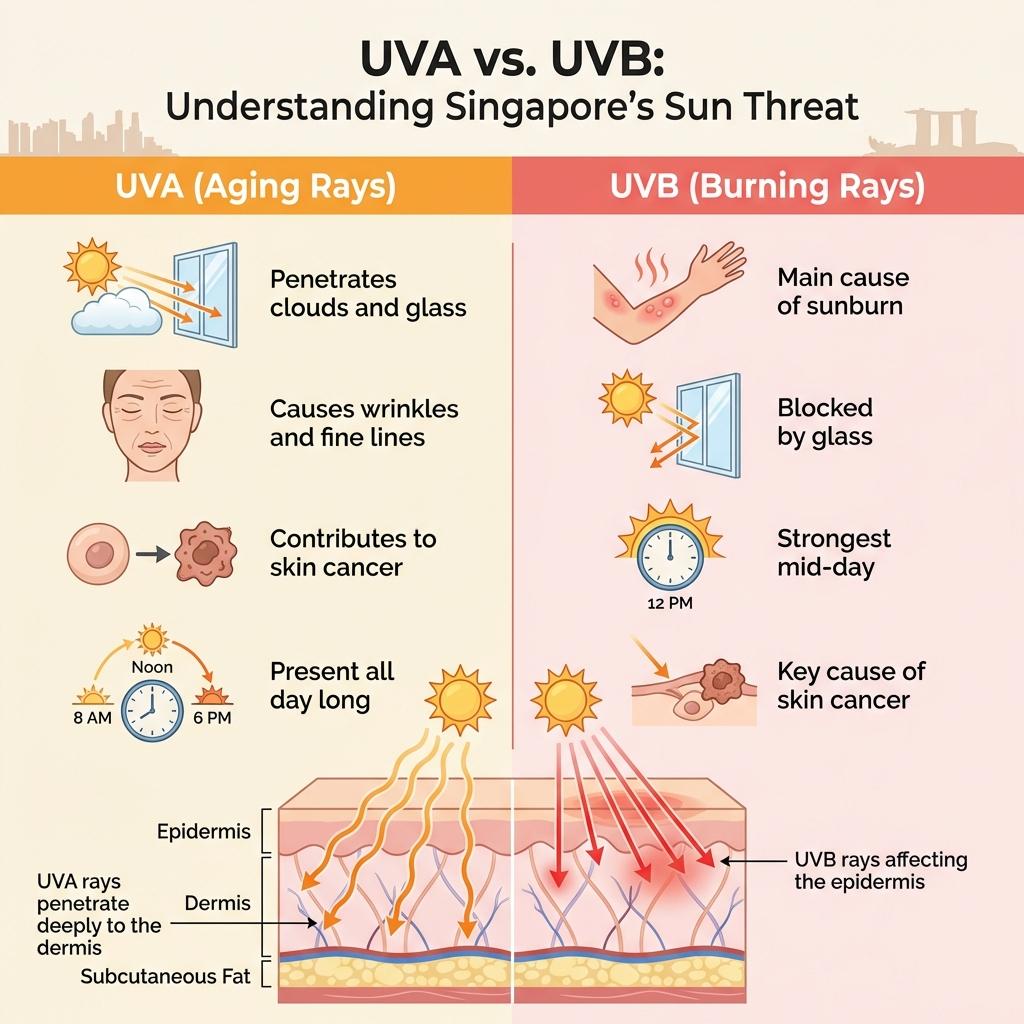
The sunlight that reaches us is composed of different types of radiation. From a skin health perspective, we are most concerned with two types: UVA and UVB rays. Think of them this way: UVA rays are the ‘aging’ rays. They have a longer wavelength that allows them to penetrate deep into the skin’s thickest layer, the dermis. This is where they damage collagen and elastin, the proteins that keep our skin firm and youthful. UVA exposure is the primary driver of wrinkles, fine lines, and sagging. UVB rays are the ‘burning’ rays. With a shorter wavelength, their effects are more superficial, primarily affecting the top layer of the skin, the epidermis. They are the main cause of sunburn and play a crucial role in the development of skin cancer. The UV Index, or UVI, is a standard international measurement of the strength of UVB radiation at a particular place and time. In Singapore, the UVI regularly reaches ‘Extreme’ levels, often hitting 11 or higher, especially between 11 a.m. and 3 p.m. At this level, unprotected skin can burn in as little as 10 to 15 minutes.
More Than a Sunburn: The Hidden Dangers of Incidental Exposure
The most visible sign of too much sun is a sunburn, but the damage goes far deeper and is often silent until years later. The primary concern with chronic, low grade sun exposure from daily commutes is photoaging. This term describes the premature aging of the skin caused by repeated exposure to UV radiation. Signs of photoaging include leathery, textured skin, fine lines, and deep wrinkles. Another common issue in Singapore is hyperpigmentation. This is the darkening of an area of skin caused by an increase in melanin. Sun exposure is a major trigger for conditions like solar lentigines (sun spots), melasma (patchy brown spots), and post-inflammatory hyperpigmentation (PIH), which is the darkening of skin after an injury like an acne breakout. The most serious risk of all is, of course, skin cancer. Both UVA and UVB rays damage the DNA in our skin cells, which can lead to mutations that cause cancerous growths. Every bit of sun exposure, no matter how short, adds up over your lifetime, increasing this risk. This cumulative damage is why protecting yourself during your daily commute is just as important as applying sunscreen for a day at the beach.
Debunking Common Myths About Sun Exposure in the City
Many people hold onto beliefs that give them a false sense of security. It is crucial to address these myths. A common one is feeling safe indoors or in a vehicle. While glass, such as car windows or office windows, effectively blocks most UVB rays, it does very little to stop the deeply penetrating UVA rays. So, if you sit by a window at work or have a long driving commute, your skin is still being exposed to aging UVA radiation. Another myth is that cloudy skies mean you are safe from the sun. In reality, up to 80 percent of the sun’s UV rays can pass through clouds. You can still get significant sun damage on an overcast day. Finally, many people believe the SPF in their makeup is sufficient. While it is better than nothing, it is rarely enough. To get the SPF protection stated on the bottle, you need to apply a thick layer of product, far more than anyone typically applies for foundation or powder. Relying on makeup for your primary sun protection is inadequate.
Decoding Sunscreen Labels: SPF, PA Ratings, and Broad Spectrum Explained
The sunscreen aisle can be a confusing place, filled with acronyms and numbers. To make an informed choice, you need to understand what these labels mean. The three most important terms to know are SPF, PA rating, and Broad Spectrum. These indicators tell you exactly what kind of protection a product offers and are essential for ensuring your skin is adequately shielded from the full range of solar radiation.
What Does SPF Really Mean? The Non-Linear Protective Factor
SPF stands for Sun Protection Factor. It is a measure of how well a sunscreen protects you from UVB rays, the kind that cause sunburn. The number indicates how much longer it would take for your skin to redden with the sunscreen on compared to without it. For instance, if you would normally burn in 10 minutes, an SPF 50 sunscreen would theoretically provide 50 times that, or 500 minutes of protection. However, this is under ideal laboratory conditions. In the real world, factors like sweat, humidity, and insufficient application reduce this effectiveness. It is also important to understand that the protection scale is not linear. SPF 15 blocks about 93% of UVB rays. SPF 30 blocks about 97%. SPF 50 blocks about 98%. The difference between 97% and 98% might seem small, but in a high UV environment like Singapore, that extra percentage point provides a crucial buffer. More importantly, since most people apply only a quarter to a half of the recommended amount of sunscreen, starting with a higher SPF like 50 ensures you get better protection even with imperfect application.
The Importance of PA+ Ratings for UVA Protection
While SPF measures UVB protection, the PA rating system is used to measure protection against UVA rays, the aging rays. Developed in Japan, this system is now widely used across Asia. The ratings are displayed as PA+, PA++, PA+++, and PA++++. The more plus signs, the higher the protection against UVA radiation. Given that UVA rays are present with relatively equal intensity during all daylight hours and can penetrate both clouds and glass, protecting against them is critical for preventing long term photoaging and reducing skin cancer risk. For life in Singapore, where you are constantly exposed to UVA rays even when indoors near a window, settling for anything less than the highest rating, PA++++, is a significant compromise for your skin health. Always look for a sunscreen that specifies this level of UVA protection.

Broad Spectrum: Your Non-Negotiable Baseline
The term “Broad Spectrum” is a regulatory designation that confirms a sunscreen product protects against both UVA and UVB rays. In the past, many sunscreens only protected against UVB, leaving users vulnerable to the aging effects of UVA. Today, any sunscreen worth considering must be labeled as broad spectrum. This ensures you are getting comprehensive protection against the full range of damaging ultraviolet light. When you combine a high SPF (50), a high PA rating (PA++++), and the broad spectrum designation, you create the most robust defense possible for your skin against the relentless Singapore sun.
Choosing the Right SPF 50 for Singapore’s Climate and Your Skin
Knowing you need SPF 50 is one thing; finding a product you are willing to wear every single day is another. The texture, finish, and formulation of a sunscreen are just as important as its protective ratings. In Singapore’s hot and humid climate, a heavy, greasy sunscreen is a recipe for discomfort and clogged pores. Thankfully, modern cosmetic science has produced a wide variety of formulas designed for different skin types and preferences.
Physical vs. Chemical Sunscreens: A Practical Comparison
Sunscreens provide protection using two main types of active ingredients: physical and chemical. Physical sunscreens, also known as mineral sunscreens, contain active mineral ingredients like zinc oxide and titanium dioxide. They work by sitting on top of the skin to create a physical barrier that blocks and scatters UV rays. They are generally well tolerated by sensitive skin but can sometimes leave a white cast, although modern micronized formulas have greatly improved this. Chemical sunscreens use organic compounds like avobenzone and octocrylene. They work by absorbing UV radiation, converting it into heat, and releasing it from the skin. These formulas tend to be lighter in texture and absorb into the skin without leaving a white residue, making them popular choices for daily wear. The best type is the one you will use consistently.
Formulations for a Humid Climate: Gels, Lotions, and Serums
The cosmetic feel of a sunscreen is paramount for daily compliance. In Singapore, lightweight formulations are key. Heavy creams can feel suffocating and sticky in the high humidity. Look for products described as gels, lotions, essences, or serums. Gel based sunscreens are often water based and feel cooling and light on the skin, making them ideal for oily skin types. Lotions and essences offer a bit more hydration without being heavy. Serum sunscreens are ultra lightweight and can be layered easily with other skincare products. Also, consider looking for a formula that is “water resistant” or “sweat resistant.” While this is often associated with swimming, it is incredibly practical for the daily commute, ensuring your protection does not simply melt off as you walk to the bus stop.
Master Your Application: The Keys to Effective Daily Protection
Even the best sunscreen in the world will not protect you if it is not applied correctly. Application technique is just as crucial as the product you choose. Most people fail to apply enough sunscreen, which dramatically compromises the level of protection they receive. Mastering a few key principles can ensure you get the full SPF 50 shield you are paying for.
How Much is Enough? The Two-Finger Rule
Dermatologists universally agree that the biggest mistake people make is under application. To achieve the SPF rating advertised on the bottle, you need to apply approximately two milligrams of product per square centimeter of skin. For the face and neck, a simple and effective way to measure this is the “two finger rule.” Squeeze a line of sunscreen along the full length of your index and middle fingers. This amount is generally what is needed to properly cover your face and neck. It might feel like a lot at first, but it is the required dose for effective protection. This is another reason why starting with SPF 50 is so important; even if you slightly under apply, you are still getting a higher level of protection than you would from an inadequately applied SPF 30.
When and How Often to Reapply
Sunscreen is not a one and done application. It should be the last step of your morning skincare routine, applied about 15 to 20 minutes before you head out the door to allow it to form a protective film on the skin. The general rule for reapplication is every two hours of direct, continuous sun exposure. For a typical office worker, this means a thorough application in the morning is sufficient until midday. However, if you go out for lunch, you should reapply before heading out. Reapplication can be tricky, especially over makeup. This is where modern formulations come in handy. Sunscreen sticks, mists, and powders are designed for easy reapplication on the go without disturbing your makeup. They are perfect for topping up your protection before your lunchtime walk or your commute home.
Your Skin’s Future is a Daily Decision
Integrating a high protection, broad spectrum SPF 50 sunscreen into your daily routine is not about vanity; it is a fundamental act of health preservation. In the context of Singapore’s relentless, year round UV exposure, the cumulative damage from thousands of daily commutes can significantly accelerate skin aging and elevate your risk for skin cancer. The choice to protect your skin is a decision that pays dividends for decades, preserving its health and vitality.
Make the application of sunscreen as automatic as brushing your teeth. Find a formula you love, apply it generously every single morning, and reapply when necessary. Your skin is your body’s largest organ, and it deserves this non negotiable daily defense. If you have specific concerns about your skin, such as changing moles, persistent pigmentation, or other issues, it is always best to seek professional medical advice. A consultation with a qualified dermatologist or skin specialist can provide you with a personalized assessment and treatment plan to ensure your skin remains healthy for life. This article is for informational purposes only and does not constitute medical advice. Please consult a healthcare professional for any medical concerns.

Jeremy Lee is a seasoned digital marketing director and strategist with over two decades of experience in the industry. As the founder of Sotavento Medios, I manage a diverse portfolio of over 50 businesses, helping brands grow through advanced search strategies and digital innovation. My work focuses on bridging the gap between traditional search engine optimisation and the evolving world of AI-driven answer engines.