
As Singapore’s population ages, concerns about memory and cognitive function naturally grow. It is common for individuals to experience occasional forgetfulness as they get older, leading many to wonder: Is this simply a normal part of aging, or could it be a sign of something more serious, like dementia or Alzheimer’s disease? Understanding the crucial distinctions between normal age-related cognitive changes and the more profound shifts associated with dementia is vital for early detection, appropriate management, and maintaining quality of life for individuals and their families across our vibrant city-state.
This article aims to provide a comprehensive, accurate, and trustworthy guide for Singaporeans aged 25-65, offering clarity on the often-confusing landscape of cognitive health. We will explore the characteristics of typical aging, delineate the warning signs of dementia, and specifically examine Alzheimer’s disease, its most common form. Our goal is to equip you with evidence-based insights and actionable information, empowering you to navigate these concerns with confidence and seek timely professional advice when needed.
The Landscape of Cognitive Changes in Aging Singapore
Normal Age-Related Cognitive Changes
Aging is an inevitable process, and with it come subtle shifts in our cognitive abilities. For many Singaporeans, these changes are generally mild and do not significantly interfere with daily life or independence. It is important to recognise that these are common experiences and not necessarily indicators of a debilitating condition.
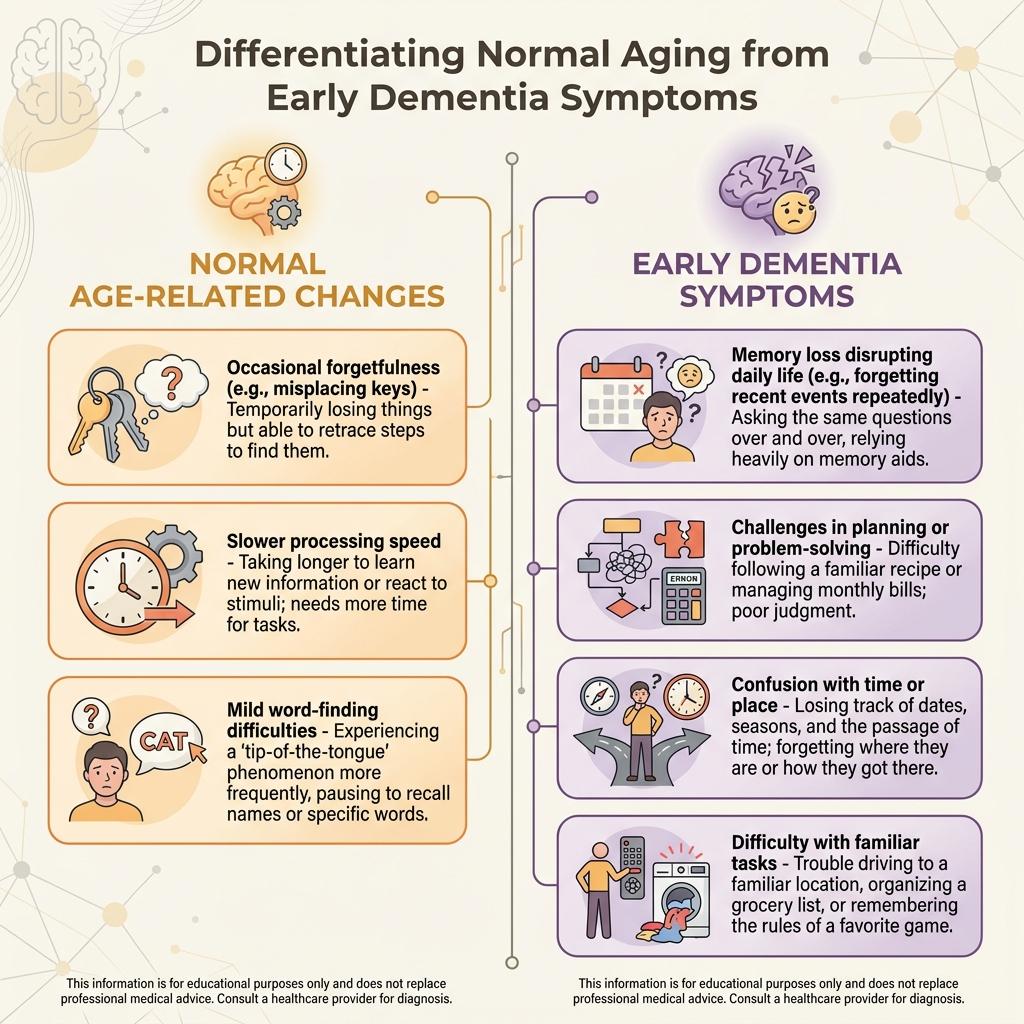
- Occasional Forgetfulness: You might occasionally forget where you placed your spectacles, keys, or even the name of an acquaintance, only to recall it later. This is different from frequently forgetting recently learned information or important events. Forgetting a specific detail from a conversation last week, but remembering the general topic, falls into this category. Similarly, misplacing a kopitiam loyalty card or forgetting an item on your grocery list is a common occurrence.
- Slower Processing Speed: It might take a little longer to process new information or to recall facts. For example, learning to use a new smartphone application or navigating a complex HDB estate might require more effort and time than it did in younger years. This is a general slowing, not an inability to learn or comprehend.
- Difficulty with Multitasking: Juggling multiple tasks simultaneously can become more challenging. You might find it harder to cook a complex Singaporean dish while simultaneously conversing and listening to the news, preferring to focus on one activity at a time.
- Word-Finding Difficulties: Experiencing the “tip-of-the-tongue” phenomenon, where you know a word but struggle to retrieve it immediately, is also typical. This usually resolves spontaneously and does not impede communication significantly.
These normal age-related changes are generally stable over time or progress very slowly. Individuals usually develop compensatory strategies, such as writing down appointments or using memory aids, and continue to function independently in their daily lives, including managing finances, social engagements, and personal care.
When to Be Concerned: Early Signs of Dementia
In contrast to normal aging, the cognitive decline associated with dementia is progressive and severe enough to significantly impair an individual’s ability to carry out everyday activities. These changes represent a departure from a person’s usual level of functioning and are noticed by the individual, their family, or their friends. Recognising these signs early is crucial for seeking timely medical evaluation.
- Memory Loss That Disrupts Daily Life: This is more than just forgetting a name occasionally. It involves forgetting recently learned information, important dates or events, repeatedly asking the same questions, or increasingly relying on memory aids or family members to remember things they once handled independently. For instance, repeatedly forgetting appointments with the doctor, or being unable to recall significant family gatherings from recent months.
- Challenges in Planning or Solving Problems: Individuals may find it difficult to follow a familiar recipe, manage monthly bills, or keep track of complex tasks. This could manifest as struggling to plan a simple outing to Gardens by the Bay or having difficulty following the steps to use an ATM.
- Difficulty Completing Familiar Tasks: People with dementia may struggle with tasks they have performed countless times before, such as driving to a familiar location, managing a budget, or playing a favourite card game. A common example might be forgetting the rules of Mahjong or struggling with the sequence of preparing a favourite home-cooked meal.
- Confusion with Time or Place: Losing track of dates, seasons, or the passage of time. They might forget where they are or how they got there. This extends beyond occasionally forgetting the day of the week, to believing it is a different year or not knowing their current location within Singapore.
- New Problems with Words in Speaking or Writing: Struggling to follow or join a conversation, repeating themselves, or having difficulty finding the right word for familiar objects (e.g., calling a “watch” a “hand-clock”).
- Misplacing Things and Losing the Ability to Retrace Steps: Placing items in unusual places (e.g., car keys in the refrigerator) and being unable to logically retrace their steps to find them.
- Decreased or Poor Judgment: Making poor decisions with money, such as giving away large sums to telemarketers, or neglecting personal hygiene.
- Withdrawal from Work or Social Activities: A person with dementia may start to withdraw from hobbies, social engagements, or work projects due to the challenges posed by their cognitive changes.
- Changes in Mood or Personality: Becoming confused, suspicious, depressed, fearful, or anxious. They may easily get upset in situations that were once routine.
These symptoms are persistent and progressive, indicating a significant decline in cognitive function beyond what is expected with normal aging. If you observe several of these changes in yourself or a loved one, it is advisable to seek a medical evaluation.
Dementia Explained: Beyond Just Forgetfulness
What is Dementia? A Medical Definition
Dementia is not a single disease but rather an umbrella term for a collection of symptoms caused by disorders that affect the brain. It is characterized by a progressive and severe decline in cognitive abilities—such as memory, thinking, language, and judgment—to an extent that it interferes with a person’s daily life and activities. While memory loss is a common and often early symptom, dementia encompasses a broader range of cognitive impairments.
It is crucial to understand that dementia is not a normal part of aging. While the risk of developing dementia increases with age, it is caused by specific brain diseases and conditions. These conditions damage brain cells, leading to a breakdown in communication between neurons, and thus impairing cognitive functions. There are various types of dementia, each with distinct underlying causes and often different patterns of symptoms. The most common types include:
- Alzheimer’s Disease: The most prevalent form, accounting for 60-80% of dementia cases.
- Vascular Dementia: Caused by damage to blood vessels in the brain, often due to strokes or mini-strokes.
- Lewy Body Dementia: Characterized by abnormal protein deposits (Lewy bodies) in the brain, leading to cognitive decline, fluctuations in alertness, and often visual hallucinations and Parkinsonian motor symptoms.
- Frontotemporal Dementia: Affects the front and side parts of the brain, leading to changes in personality, behaviour, and language.
- Mixed Dementia: A combination of two or more types of dementia, most commonly Alzheimer’s and vascular dementia.
The Spectrum of Symptoms and Progression
The symptoms of dementia can vary widely depending on the type and the areas of the brain affected. However, common threads typically include a progressive decline in several cognitive domains:
- Memory Loss: Particularly for recent events and new information.
- Language Difficulties (Aphasia): Trouble finding words, understanding conversations, or reading and writing.
- Impaired Judgment and Reasoning (Executive Dysfunction): Difficulty with planning, problem-solving, decision-making, and understanding consequences.
- Visual-Spatial Problems (Agnosia): Difficulty interpreting visual information, leading to problems with depth perception, navigation, or recognizing familiar objects or faces. This might manifest as difficulty judging distances when crossing a road or navigating within a familiar HDB block.
- Emotional and Personality Changes: Mood swings, apathy, irritability, depression, anxiety, or uncharacteristic behaviour.
- Difficulty with Activities of Daily Living (ADLs): As dementia progresses, individuals may struggle with basic tasks like dressing, bathing, eating, and personal hygiene.
The progression of dementia is generally slow and gradual, often over many years. Initially, symptoms may be mild (mild cognitive impairment), but they worsen over time, leading to increasing dependence on caregivers. Understanding this progression helps families and caregivers in Singapore plan for future care needs and access available support services from organisations like the Agency for Integrated Care (AIC).

Alzheimer’s Disease: The Most Prevalent Form of Dementia
Understanding Alzheimer’s Pathophysiology
Alzheimer’s disease is a progressive neurodegenerative disorder that slowly destroys memory and thinking skills, and eventually, the ability to carry out the simplest tasks. It is the most common cause of dementia, and its hallmark features are microscopic changes in the brain tissue.
The primary pathological hallmarks of Alzheimer’s disease are:
- Amyloid Plaques: These are abnormal clumps of a protein fragment called beta-amyloid that accumulate in the spaces between nerve cells. While beta-amyloid is naturally produced, in Alzheimer’s, it forms insoluble plaques that disrupt cell function.
- Neurofibrillary Tangles: These are twisted fibres of another protein called tau, which accumulate inside nerve cells. In a healthy brain, tau helps stabilise the internal scaffolding of brain cells (microtubules). In Alzheimer’s, tau detaches from microtubules and forms tangles, disrupting the transport system and ultimately leading to cell death.
These plaques and tangles, along with the loss of connections between nerve cells and brain cell death, lead to brain shrinkage and a decline in cognitive function. The precise mechanism by which these pathologies lead to symptoms is still being researched, but it is clear they play a central role in the disease process.
Risk factors for Alzheimer’s disease include:
- Age: The greatest known risk factor; most individuals with Alzheimer’s are 65 and older.
- Genetics: While not exclusively genetic, specific genes (e.g., APOE-e4 allele) can increase risk.
- Lifestyle and Health Conditions: Growing evidence suggests a strong link between brain health and overall heart health. Conditions common in Singapore like hypertension, diabetes, obesity, high cholesterol, smoking, and lack of physical activity can increase the risk of Alzheimer’s and vascular dementia. Maintaining a healthy lifestyle, including a balanced diet (like the traditional Singaporean diet adapted for health, focusing on fresh ingredients), regular exercise, and managing chronic conditions, is crucial for brain health.
Clinical Presentation and Diagnostic Process in Singapore
The onset of Alzheimer’s disease is typically gradual and insidious. Early symptoms are often subtle and may be dismissed as normal aging, making early diagnosis challenging. Memory loss, particularly of recent events, is usually the most prominent early symptom, but other cognitive deficits also emerge.
Diagnosing Alzheimer’s disease in Singapore involves a comprehensive evaluation by a medical professional, often a neurologist or geriatrician at polyclinics or hospitals such as the National Neuroscience Institute or various public hospital geriatric departments. The diagnostic process typically includes:
- Medical History: Detailed information about the patient’s symptoms, medical background, and family history.
- Cognitive Assessments: Standardized tests to evaluate memory, thinking skills, language, and problem-solving abilities (e.g., Mini-Mental State Examination, Montreal Cognitive Assessment).
- Neurological Examination: To rule out other conditions that might cause similar symptoms.
- Brain Imaging: Magnetic Resonance Imaging (MRI) or Computed Tomography (CT) scans may be used to identify structural changes in the brain (like shrinkage), rule out other causes (e.g., tumours, strokes), and sometimes aid in confirming a diagnosis. Positron Emission Tomography (PET) scans, which can detect amyloid plaques or tau tangles, are also available in some centres and can provide more definitive evidence of Alzheimer’s pathology.
- Blood Tests: To rule out other reversible causes of cognitive impairment, such as vitamin deficiencies, thyroid problems, or infections.
An early and accurate diagnosis is essential. While there is currently no cure for Alzheimer’s disease, early diagnosis allows for medical treatments that can temporarily slow the progression of symptoms in some individuals and helps families plan for the future. It also allows individuals to participate in clinical trials and access support services available through various organisations in Singapore.
Differentiating Normal Aging, Mild Cognitive Impairment (MCI), and Dementia
Normal Aging vs. Mild Cognitive Impairment (MCI)
The distinction between normal aging, Mild Cognitive Impairment (MCI), and dementia is a spectrum rather than a strict dividing line. Understanding where an individual falls on this spectrum is critical for appropriate care and prognosis.
- Normal Aging: As discussed, involves occasional memory lapses, slower processing, and minor word-finding difficulties that do not significantly impact daily life. The individual remains fully independent and capable of managing all their responsibilities. Forgetting a specific detail from a conversation is normal.
- Mild Cognitive Impairment (MCI): MCI represents a stage between the expected cognitive decline of normal aging and the more severe decline of dementia. Individuals with MCI experience more significant memory or other cognitive problems than expected for their age, but these problems are not severe enough to interfere with their independence or daily activities. For example, a person with MCI might consistently forget important appointments, struggle to recall recent conversations, or find familiar tasks more challenging, but they can still manage their finances, travel independently (e.g., take the MRT to different parts of Singapore), and perform personal care. While MCI is a risk factor for dementia, not everyone with MCI progresses to dementia; some individuals remain stable, and a few may even improve. Regular monitoring by a doctor is crucial for individuals diagnosed with MCI.
Diagnostic Criteria and Clinical Features
The table below provides a concise overview of the key differentiating features:
Differentiating Features of Normal Aging, MCI, and Dementia
- Memory Loss:
- Normal Aging: Occasional forgetfulness, able to recall later.
- MCI: Consistent, noticeable memory problems, but still manages daily life.
- Dementia: Significant, disruptive memory loss, severely impacting daily life.
- Impact on Daily Life/Function:
- Normal Aging: No impact on independence or activities of daily living (ADLs).
- MCI: Minimal or no impact on ADLs; maintains independence.
- Dementia: Significant impairment in ADLs; loss of independence.
- Problem-Solving/Decision Making:
- Normal Aging: May be slower, but skills remain intact.
- MCI: Mild difficulties, but generally able to make sound decisions.
- Dementia: Significant difficulties with planning, judgment, and decision-making.
- Language Skills:
- Normal Aging: Occasional word-finding difficulty, quickly resolves.
- MCI: Mild word-finding or comprehension issues.
- Dementia: Frequent difficulty finding words, understanding, or expressing thoughts.
- Orientation (Time/Place):
- Normal Aging: Rarely disoriented.
- MCI: May occasionally get confused in unfamiliar settings.
- Dementia: Frequently confused about date, time, and location.
- Progression:
- Normal Aging: Stable or very slow progression.
- MCI: Slow progression, but at higher risk for dementia.
- Dementia: Progressive and worsening over time.
A definitive diagnosis requires a thorough evaluation by a healthcare professional who can conduct cognitive tests, neurological examinations, and potentially brain imaging to assess the extent and pattern of cognitive decline. It is essential not to self-diagnose but to seek expert medical opinion.
Management and Support in Singapore
Lifestyle Interventions and Brain Health
While there is no cure for Alzheimer’s disease, and some forms of dementia are irreversible, adopting a brain-healthy lifestyle can significantly reduce the risk of cognitive decline and potentially delay the onset or slow the progression of symptoms. These strategies are beneficial for all Singaporeans, regardless of age or current cognitive status.
- Physical Activity: Regular exercise, such as brisk walking around your neighbourhood, tai chi in community parks, or swimming at public pools, improves blood flow to the brain, reduces inflammation, and promotes the growth of new brain cells. Aim for at least 150 minutes of moderate-intensity aerobic exercise per week.
- Healthy Diet: A diet rich in fruits, vegetables, whole grains, lean proteins, and healthy fats is crucial. The Mediterranean diet and the MIND diet (Mediterranean-DASH Intervention for Neurodegenerative Delay) have shown promise in promoting brain health. This can be adapted to Singaporean cuisine by favouring whole grains like brown rice, plenty of leafy greens, fish, and limiting processed foods, excessive sugar, and unhealthy fats often found in certain local hawker fare.
- Social Engagement: Maintaining strong social connections and participating in community activities can help keep the brain active and reduce the risk of isolation and depression, both of which are risk factors for cognitive decline. Engaging in activities at local community centres, befriending programmes, or senior activity centres are excellent ways to stay connected.
- Cognitive Stimulation: Keep your brain active with mentally stimulating activities. This could include learning a new language (perhaps a local dialect or a third language), playing strategy games like chess or Mahjong, reading books, solving puzzles, or picking up new hobbies.
- Manage Chronic Health Conditions: Effectively managing conditions like hypertension, diabetes, high cholesterol, and obesity is paramount, as these are significant risk factors for vascular dementia and can exacerbate Alzheimer’s disease. Regular check-ups at polyclinics and adherence to treatment plans are essential.
- Adequate Sleep: Prioritise 7-9 hours of quality sleep per night. Sleep is vital for brain health, as it allows the brain to clear waste products and consolidate memories.
- Avoid Smoking and Limit Alcohol: Smoking significantly increases the risk of cognitive decline and dementia. Excessive alcohol consumption is also detrimental to brain health.
When to Seek Medical Attention and Available Resources
It is important to remember that general awareness about cognitive health should not replace professional medical advice. If you or a loved one are experiencing persistent and worsening memory issues, or any other cognitive changes that are impacting daily life, it is crucial to seek a medical evaluation promptly. Do not delay seeking help out of fear or uncertainty.
In Singapore, you can seek initial consultation at polyclinics, which can provide referrals to specialists. For more comprehensive assessment and diagnosis, consult with a general practitioner, a neurologist, or a geriatrician at public hospitals (such as National University Hospital, Singapore General Hospital, Changi General Hospital, Khoo Teck Puat Hospital) or specialist centres like the National Neuroscience Institute. These professionals can conduct thorough evaluations to determine the cause of symptoms and provide an accurate diagnosis.
Furthermore, Singapore offers various support systems for individuals with dementia and their caregivers. The Agency for Integrated Care (AIC) is a key touchpoint for information on care services, financial assistance, and caregiver support programmes. Support groups and community-based services also provide invaluable emotional and practical assistance. Early intervention and support can significantly improve the quality of life for those affected and their families.
Conclusion: Empowering Cognitive Health in Singapore
Understanding the intricate differences between normal age-related memory changes and the more serious symptoms of dementia, including Alzheimer’s disease, is a powerful first step towards proactive cognitive health. While a certain degree of cognitive slowing is natural with age, significant and progressive declines that interfere with daily functioning warrant immediate medical attention. We hope this comprehensive guide has clarified these distinctions for our Singaporean readers, empowering you with the knowledge to identify potential concerns early.
Remember, maintaining a brain-healthy lifestyle through physical activity, a balanced diet, social engagement, and cognitive stimulation is beneficial at any age. If you or someone you care about exhibits persistent symptoms beyond what is considered normal aging, please consult a healthcare professional in Singapore. Early diagnosis opens doors to potential treatments, better management strategies, and access to vital support networks, ensuring that every individual can live their best possible life with dignity and support.

Jeremy Lee is a seasoned digital marketing director and strategist with over two decades of experience in the industry. As the founder of Sotavento Medios, I manage a diverse portfolio of over 50 businesses, helping brands grow through advanced search strategies and digital innovation. My work focuses on bridging the gap between traditional search engine optimisation and the evolving world of AI-driven answer engines.